

Adult patient guide · Consultant-led urology
Frenuloplasty for a Short Frenulum in Birmingham
Symptoms, assessment, treatment choices, recovery and possible risks—explained in calm, patient-friendly language.
Patient information from Birmingham Advanced Urology
Mr Syed Ali Shahzad · FRCS (Urol), FEBU · Consultant Urological and Robotic Surgeon · GMC 6071731
Article updated 1 November 2026.

Pain, pulling or recurrent bleeding during sex can be caused by a short or tight frenulum. Similar symptoms can also occur with a tight foreskin, inflammation, infection or a scarring skin condition, so an examination is important before deciding on treatment.
Frenuloplasty is a small operation that lengthens a tight frenulum while preserving the foreskin. This guide explains what an assessment involves, when surgery may help, what recovery is like and what risks should be considered.
Frenuloplasty at a glance
Main aim: to reduce tension, pain and recurrent tearing while preserving the foreskin. Many patients improve, but results cannot be guaranteed.
What is the frenulum?
The frenulum is an elastic fold of tissue on the underside of the penis. It runs from below the urethral opening on the glans (head of the penis) to the inner surface of the foreskin. It helps the foreskin move and return over the glans.
The frenulum contains blood vessels, so a small tear can sometimes bleed briskly.
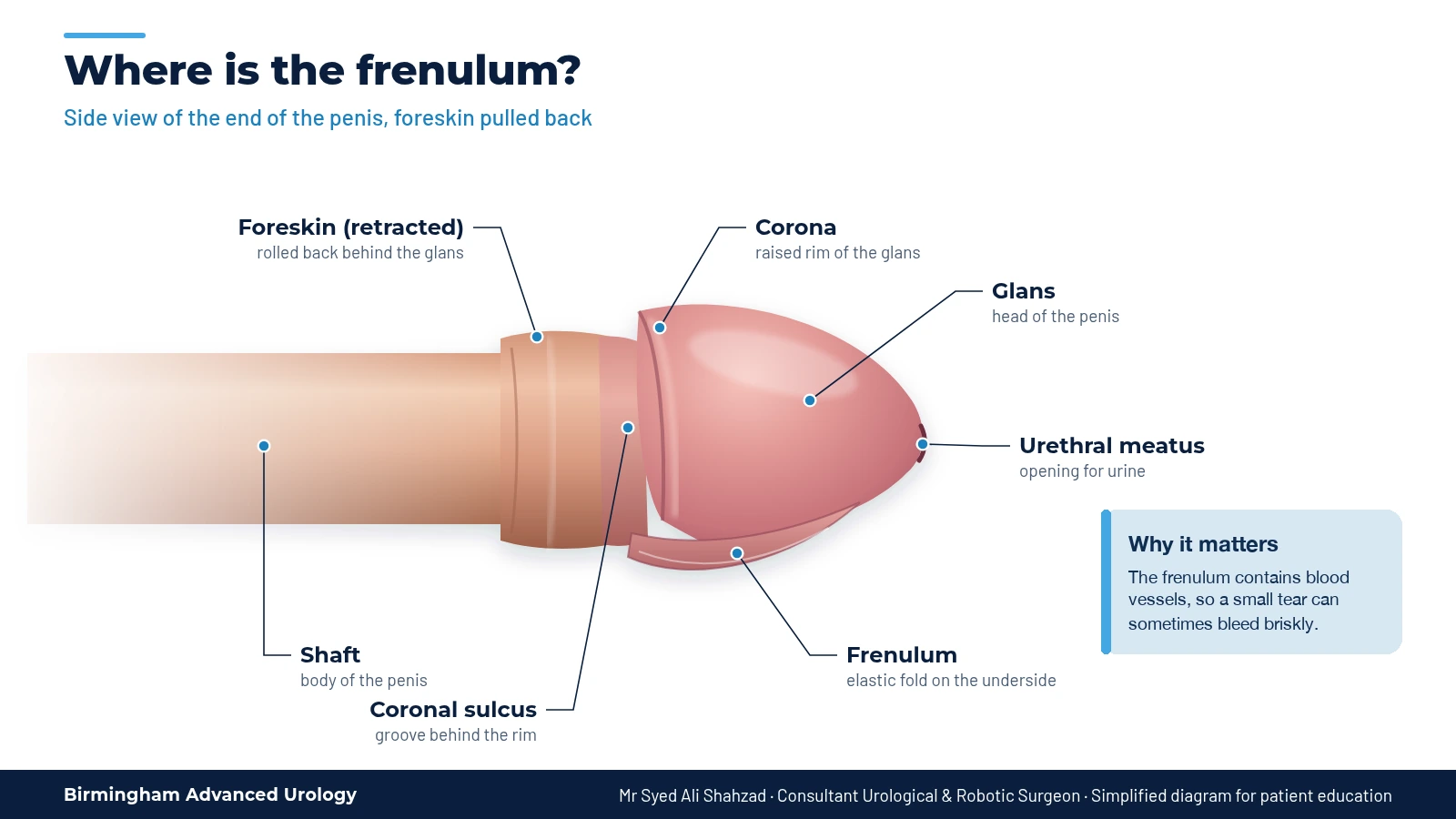
What is a short or tight frenulum?
In some men the frenulum is shorter or less elastic than usual. Doctors call this frenulum breve. During an erection, the short tissue can be pulled tight as the foreskin moves back. It may have been present for many years, or become less flexible after a tear heals with scar tissue.
Possible symptoms
- pain, pulling or tightness beneath the glans during erections, sex or masturbation;
- the glans being pulled downwards during erection;
- a small tear with sudden bleeding;
- repeated tearing after the area appears to have healed;
- difficulty retracting the foreskin fully; or
- worry about pain or tearing that affects sexual confidence or relationships.
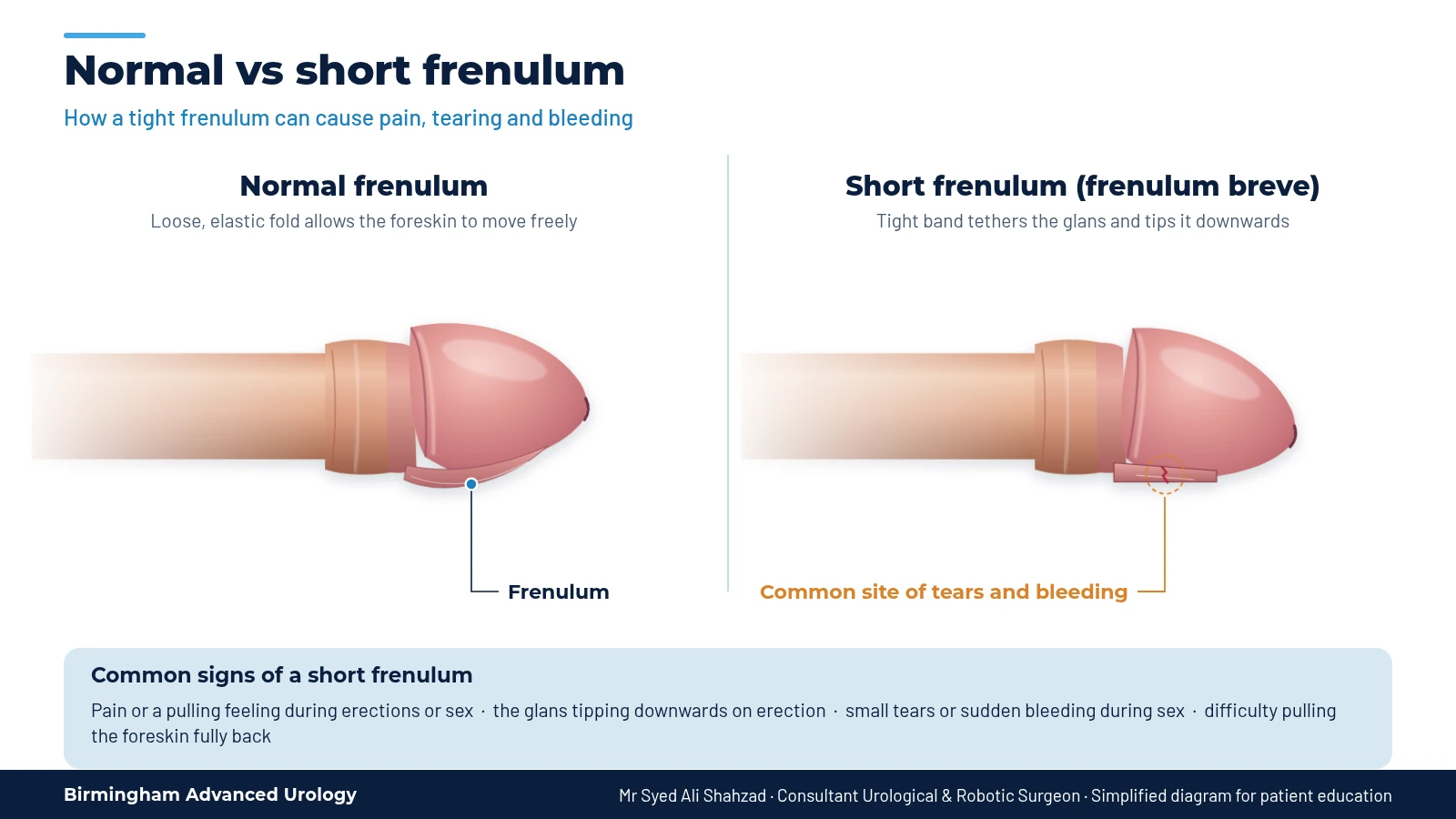
An examination is important. Similar symptoms can occur with phimosis, balanitis, infection, trauma or a scarring skin condition such as lichen sclerosus. Arrange an assessment for new white patches, progressive scarring, an ulcer, a lump, discharge, repeated inflammation or a foreskin that has recently become tight.
When should I seek urgent help?
Go to A&E or call 999
If the foreskin is trapped behind the glans and cannot be brought forward, particularly if the glans is swollen or painful. This is paraphimosis and is a medical emergency. Seek emergency help if you cannot pass urine.
If there is bleeding
Apply firm, continuous pressure with clean gauze or cloth. If bleeding is heavy, you feel faint or it does not stop, seek urgent medical help.
Contact a clinician or NHS 111
Seek advice for increasing redness, discharge, fever, worsening pain or difficulty passing urine.
What happens at the consultation?
The consultation should establish what is causing the problem before any treatment is recommended. Mr Shahzad will ask about pain, pulling, tearing or bleeding; erections and sexual activity; foreskin movement; inflammation; previous treatment; medicines; allergies; and relevant medical conditions.
A private examination helps determine whether the problem is confined to the frenulum or whether there is also phimosis, scarring, lichen sclerosus or another condition. The examination will be explained beforehand. You can ask for it to stop at any time, and you should be offered a chaperone.
Your options, expected benefits, limitations and individual risks will then be discussed. Choosing not to have an operation is also an option.
Treatment choices
Can a short frenulum be managed without surgery?
- Observation: BAUS lists no specific treatment as an option in mild cases.
- Allow a fresh tear to heal: avoid sex and masturbation until the area has healed. Lubricant may reduce friction afterwards, but it does not lengthen a short frenulum.
- Treat another cause: if examination shows inflammation, infection, phimosis or a skin condition, treatment should address that diagnosis.
Do not begin stretching or use steroid creams unless a clinician has examined you and specifically advised it, particularly if there is scarring, inflammation or white patches.
Is frenuloplasty the right operation for me?
Frenuloplasty may be considered when symptoms are caused by a short or scarred frenulum and the foreskin is otherwise suitable to preserve.
| Option | When it may be considered | Important points |
|---|---|---|
| Observation | Symptoms are mild or occasional | No operation; symptoms may continue or a tear may recur |
| Frenuloplasty | A short or scarred frenulum is the main problem | Preserves the foreskin; symptoms may not improve enough and circumcision may still be needed |
| Circumcision | The foreskin is also tight, scarred or affected by skin disease, or frenuloplasty has not provided enough relief | Removes the foreskin and permanently changes its appearance |
In selected cases, a surgeon may discuss excising rather than lengthening the frenulum. Terminology and technique vary, so this should be explained as part of your individual surgical plan.
How is frenuloplasty performed?
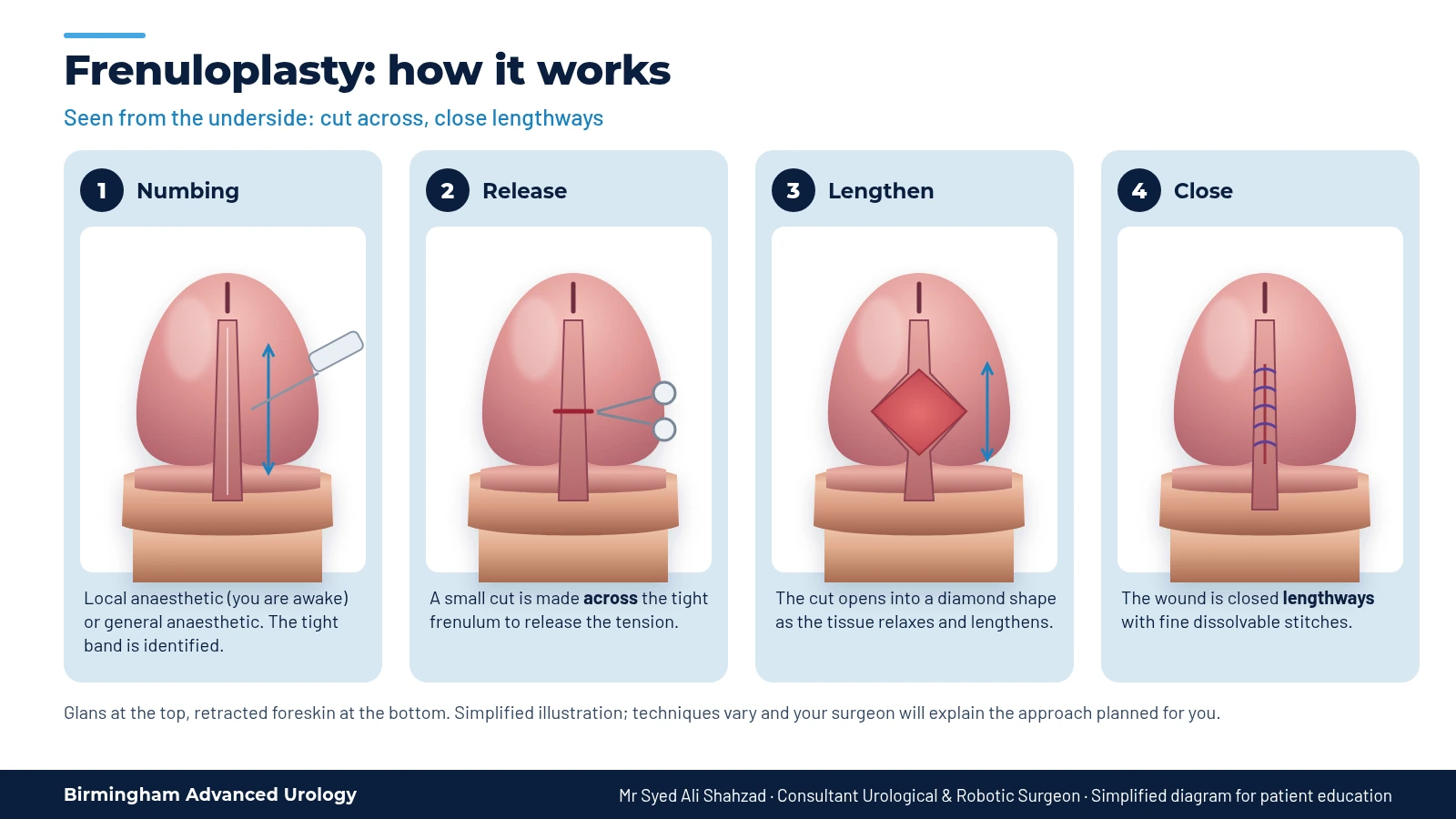
BAUS describes surgical treatment as dividing the tight tissue across and re-stitching it lengthways. Several techniques are used; the approach should be tailored to the examination findings.
- AnaestheticThe operation may be performed under local or general anaesthetic. Local anaesthetic may also be used for pain relief afterwards.
- ReleaseThe tight part of the frenulum is divided to release tension.
- LengtheningThe tissue is rearranged to gain length.
- ClosureFine dissolvable stitches may be used to hold the tissue in its new position.
Most patients go home on the same day.
Preparing for surgery
Follow the hospital’s instructions about eating, drinking and arrival time. Tell the team about allergies, implanted devices, previous MRSA infection and all medicines or supplements you take.
It is particularly important to mention blood-thinning medicines such as warfarin, aspirin, clopidogrel, apixaban or rivaroxaban. Do not stop an anticoagulant or antiplatelet medicine unless the clinical team tells you to.
If you are having sedation or a general anaesthetic, follow the hospital’s transport and supervision advice. Ask when you can drive, work and resume exercise.
What should I expect on the day?
The surgical team will confirm your history, medicines, consent and planned procedure. An anaesthetist will discuss the anaesthetic if required. Tell the team immediately if anything has changed, including a new infection, rash or medication.
With local anaesthetic, you may feel touch or pressure but should not feel sharp pain. Tell the team immediately if you feel pain. After the procedure you will be monitored, given wound-care instructions and told who to contact if there is a problem.
Recovery after frenuloplasty
Everyone heals at a different pace. Follow the discharge advice from your own surgical team.
First 24 to 48 hours
Soreness, swelling and bruising are common. Follow dressing advice, keep the area dry for 24 to 48 hours, avoid soaking, and use only the pain relief advised.
First one to two weeks
Swelling should settle gradually. Avoid swimming, keep the wound clean and dry after passing urine, and use petroleum jelly only if advised.
Stitches and foreskin movement
Dissolvable stitches usually disappear in two to three weeks. Gently retract daily only as far as comfortable and according to your surgeon’s instructions.
Sex and masturbation
Avoid for up to four weeks or until the wound is fully healed. Follow your surgeon’s specific advice.
Work
Return depends on discomfort, the anaesthetic and the physical demands of your job.
Driving
Only drive when you can safely control the vehicle and perform an emergency stop. Follow the hospital’s advice.
Benefits, limitations and possible risks
Frenuloplasty aims to reduce tension, pain and recurrent tearing while preserving the foreskin. Many patients improve, but results cannot be guaranteed.
The figures below are approximate population ranges from the BAUS patient leaflet. Your individual risk may be higher or lower, and very rare complications are not listed separately.
| Possible after-effect | Approximate BAUS frequency |
|---|---|
| Swelling lasting 7 to 14 days | Between 1 in 2 and 1 in 10 patients |
| Reduced sensation in the glans | Between 1 in 10 and 1 in 50 patients |
| Bleeding needing a hospital visit and further treatment | Between 1 in 10 and 1 in 50 patients |
| Insufficient symptom improvement, possibly leading to circumcision | Between 1 in 10 and 1 in 50 patients |
| Wound infection needing antibiotics or further treatment | Between 1 in 50 and 1 in 250 patients |
| Tenderness of the scar | Between 1 in 50 and 1 in 250 patients |
| Dissatisfaction with the cosmetic result | Between 1 in 50 and 1 in 250 patients |
| Serious anaesthetic or cardiovascular complications, including chest infection, blood clots, heart attack, stroke or death | Collectively less than 1 in 250 patients; the anaesthetist assesses individual risk |
Published evidence on long-term outcomes is encouraging but limited by small studies and a lack of high-quality comparative trials. This is why a personal assessment and realistic discussion of expected benefit are important.
Why choose consultant-led care?
Mr Syed Ali Shahzad is a Consultant Urological and Robotic Surgeon with FRCS (Urol) and FEBU qualifications. The focus is on discreet assessment, a clear diagnosis and shared decision-making. Surgery is recommended only when it is considered appropriate after examination.
Read more about Mr Shahzad, view locations, explore penile and foreskin conditions or contact the practice.
Frequently asked questions
Is frenuloplasty painful?
Local anaesthetic should prevent sharp pain during the procedure, although you may feel touch or pressure. Tell the team immediately if you feel pain. Some soreness and swelling are expected afterwards.
How long does the procedure take?
It is usually a short day-case procedure. The exact theatre and hospital time depends on the anaesthetic and your individual care plan.
When can I have sex after frenuloplasty?
BAUS advises avoiding intercourse and masturbation for up to four weeks or until the wound is fully healed. Follow your surgeon’s specific advice.
Will frenuloplasty change the appearance of my penis?
The foreskin is preserved, but a scar and some change beneath the glans are expected. BAUS lists dissatisfaction with the cosmetic result as an uncommon risk.
Can sensation change?
Yes. BAUS estimates reduced sensation in the glans in between 1 in 10 and 1 in 50 patients. Discuss the potential impact before deciding on surgery.
Might I still need circumcision?
Yes. Circumcision may be recommended if the foreskin is also tight, scarred or affected by skin disease, or if frenuloplasty does not provide sufficient relief.
What should I do if the frenulum tears?
Stop sexual activity and apply firm, continuous pressure with clean gauze or cloth. Seek urgent help if bleeding is heavy, you feel faint or it does not stop. Avoid sex and masturbation until the area has healed, and arrange an assessment if tearing recurs.
Do I need a GP referral?
Self-pay patients can usually contact the practice directly. Insurers may require a GP referral or pre-authorisation, so check your policy before booking.
Sources and further reading
- British Association of Urological Surgeons: Frenuloplasty and the linked Penile Frenulum leaflet (published June 2024; review due September 2026; still publicly listed when checked 1 November 2026).
- NHS: Tight foreskin (phimosis).
- NHS: Circumcision.
- GMC: Intimate examinations and chaperones.
- Review of frenuloplasty techniques and outcomes (PubMed).
Medical disclaimer: This adult patient guide provides general information and does not replace a consultation, examination or individual medical advice. Treatment decisions should be based on assessment by a suitably qualified clinician. Seek urgent help for severe pain, heavy or persistent bleeding, inability to pass urine, or a foreskin trapped behind a swollen or painful glans.