

Men’s health · Permanent contraception
No-scalpel vasectomy in Birmingham
Understand the procedure, recovery, risks and semen-test clearance before deciding whether vasectomy is right for you.
Considering a vasectomy is a decision about your future, as well as a procedure. This guide explains what a no-scalpel vasectomy involves, how it differs from conventional surgery and what happens afterwards. It also covers the practical questions patients often ask about sex, work, exercise and follow-up tests.
Birmingham Advanced Urology offers private consultation and individual treatment planning with Mr Syed Ali Shahzad, Consultant Urological and Robotic Surgeon, for patients across Birmingham, Worcestershire and the West Midlands.
What does a vasectomy change?
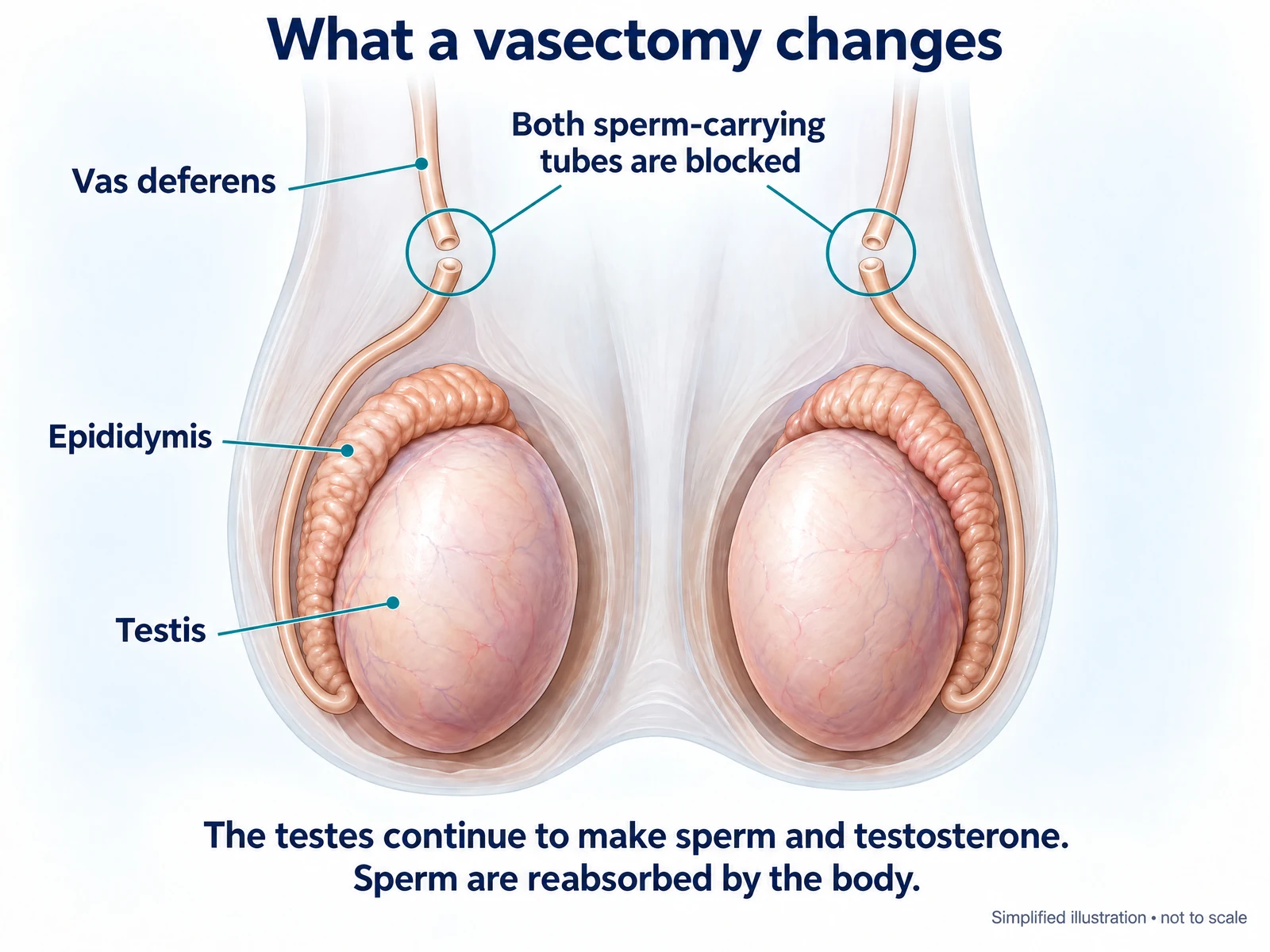
Sperm are made in the testes and mature in the epididymis, a coiled tube alongside each testis. They then travel through a tube on each side called the vas deferens. Fluid from the prostate and seminal vesicles makes up most of the semen released during ejaculation.
A vasectomy divides and blocks both vas deferens in the scrotum. Sperm can no longer travel through these tubes into the semen. The testes remain in place and continue to produce sperm and testosterone; sperm are gradually reabsorbed by the body.
What makes it “no-scalpel”?
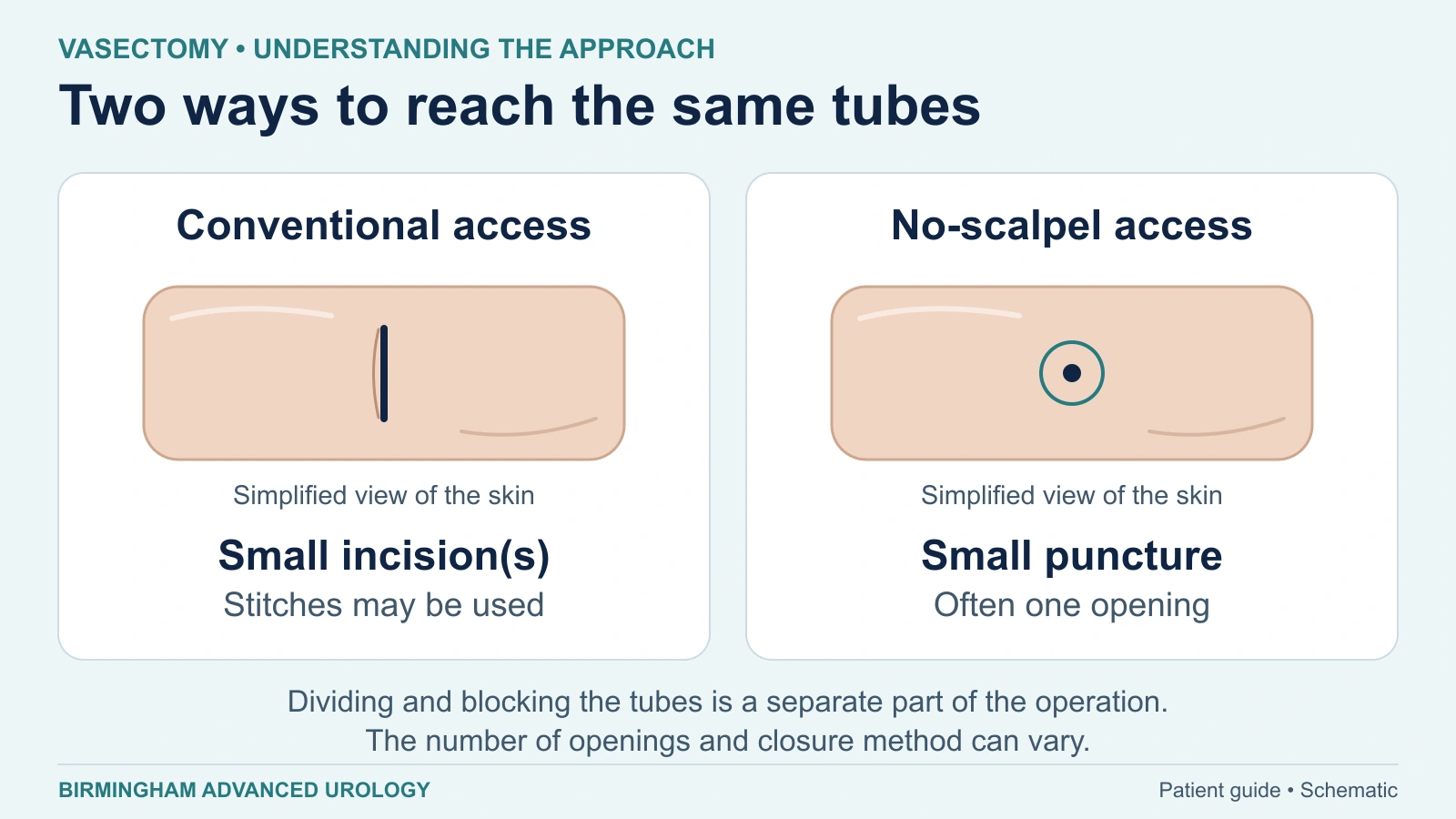
The terms no-scalpel and non-scalpel vasectomy describe how the surgeon reaches the tubes through the skin. A small puncture is gently widened, often allowing both tubes to be treated through one opening. Stitches are often unnecessary, but the number of openings and closure method can vary.
Conventional access uses one or more small incisions. In either approach, the tubes must then be divided and blocked. The skin-access method and the tube-blocking method are separate parts of the operation; your surgeon will explain the technique planned for you.
| Feature | Conventional access | No-scalpel access |
|---|---|---|
| Skin opening | Small incision or incisions | Small puncture, often one opening |
| Stitches | May be used | Often not needed |
| Short-term complications | Bleeding, bruising, infection and pain can occur | Trials suggest lower rates of some short-term complications |
| Contraceptive effectiveness | Similar: reliable blocking of the tubes and follow-up confirmation remain essential | |
A Cochrane review of trials comparing the approaches found benefits for no-scalpel access, particularly in the larger trial. This does not mean that it eliminates complications or guarantees a particular recovery.
The procedure, step by step
Most vasectomies are performed with local anaesthetic, while you are awake. The team checks your consent and the planned procedure beforehand. Tell them about medicines, allergies, previous operations and any concerns about pain or anxiety.
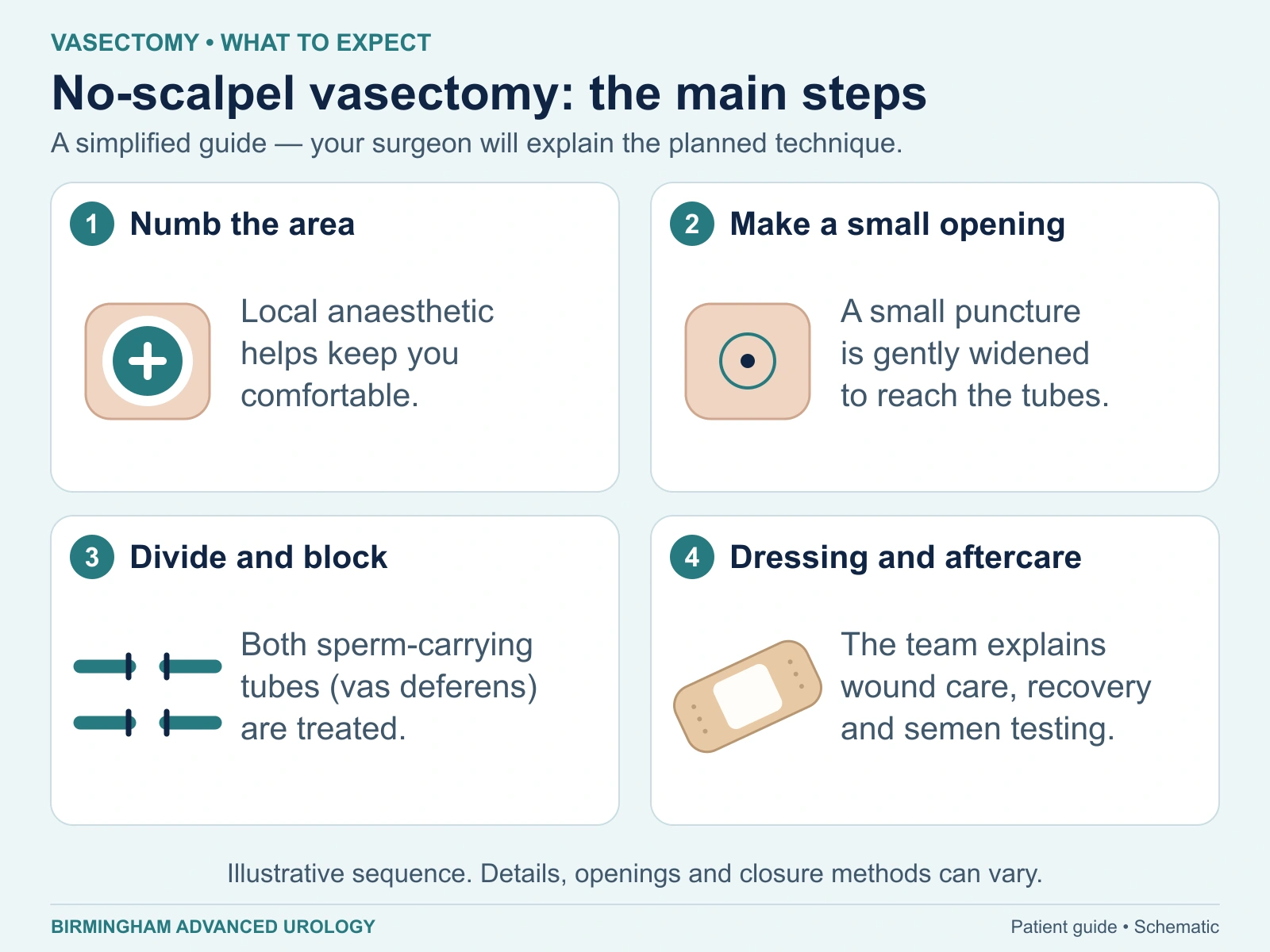
- Numbing the area. Local anaesthetic is used around the skin and tube. The injection can briefly sting. You may notice pressure or pulling; tell the team if you are uncomfortable so they can respond.
- Reaching the tubes. The surgeon locates and holds a vas beneath the skin, makes a small puncture and gently widens it to bring a short section into view.
- Dividing and blocking both tubes. Methods include sealing the inner lining with heat (cautery) and separating the ends with a tissue layer, called fascial interposition. This helps reduce reconnection. The other vas is also treated.
- Dressing and aftercare. The wound is checked, the opening is closed or left to heal as appropriate, and aftercare and semen-test arrangements are explained.
Tube-blocking techniques are discussed in the 2026 AUA vasectomy guideline. This guide explains general principles; it does not specify a single technique for every patient.
Extra planning may be needed for marked anxiety, previous scrotal surgery or tubes that are difficult to feel. Your consultation establishes the safest practical approach and any anaesthetic options. “No-needle” anaesthesia is a separate term and is not implied by “no-scalpel”.
What are the benefits?
- Highly effective long-term contraception once success has been confirmed by the clinical team.
- A small skin opening and usually a day-case procedure, with local anaesthetic suitable for many patients.
- Lower short-term complication rates in comparative trials for no-scalpel access, including less bleeding and procedural pain.
- No ongoing contraceptive medication or device is needed for pregnancy prevention after clearance. Condoms may still be needed to reduce STI risk.
- No reduction in testosterone production. Vasectomy blocks sperm transport rather than removing the testes.
Vasectomy is usually less invasive than abdominal female sterilisation, but alternatives should be considered in the context of both partners’ preferences and circumstances. Its permanence is a benefit only when you are confident about the decision.
Risks, side effects and possible failure
Temporary aching, bruising and swelling are common after vasectomy. Less common problems include infection, a collection of blood (haematoma), a small lump related to sperm leakage (sperm granuloma), or ongoing scrotal pain. No technique removes all risk.
| Issue | What it can mean |
|---|---|
| Bleeding or infection | Worsening swelling, pain, redness or discharge needs assessment. Antibiotics or further treatment may be needed. |
| Persistent scrotal pain | Pain affecting everyday life is commonly estimated at around 1–2%. Assessment and treatment may be needed; occasionally this includes surgery. |
| Early failure | About 1 in 250 is a commonly quoted counselling estimate. If sperm persist, further tests help determine whether another procedure is needed. A positive first sample is not automatically surgical failure. |
| Late failure after clearance | Commonly quoted as about 1 in 2,000. Rare reconnection can allow a pregnancy even after testing has confirmed success. |
These are general estimates from BAUS patient information, not an audited complication rate for this clinic. Studies use different definitions; your surgeon will discuss the risks relevant to you.
Persistent pain is different from the expected early ache. It can affect exercise, sexual activity or quality of life, and should not simply be ignored. Treatment may include medicines and specialist assessment; further procedures do not guarantee that pain will resolve. See NHS advice on vasectomy complications.
Will vasectomy change sex, hormones or semen?
Testosterone enters the bloodstream rather than travelling through the vas deferens, so vasectomy does not lower its production. Sex drive, erections and orgasm are not expected to be affected. Most men notice no meaningful change in semen because sperm contribute only a small part of its volume.
This reassurance is not a guarantee that sexual activity will feel unchanged for every individual: temporary discomfort, and less commonly persistent pain, can have an effect. Allow recovery before restarting sex and discuss ongoing symptoms with your clinician. NHS recovery and sexual-health advice.
Vasectomy does not protect against sexually transmitted infections. Condoms remain relevant where there is an STI risk.
Recovery and aftercare
Follow the instructions supplied by your own clinical team. Recovery varies with discomfort, the procedure and the physical demands of your work.
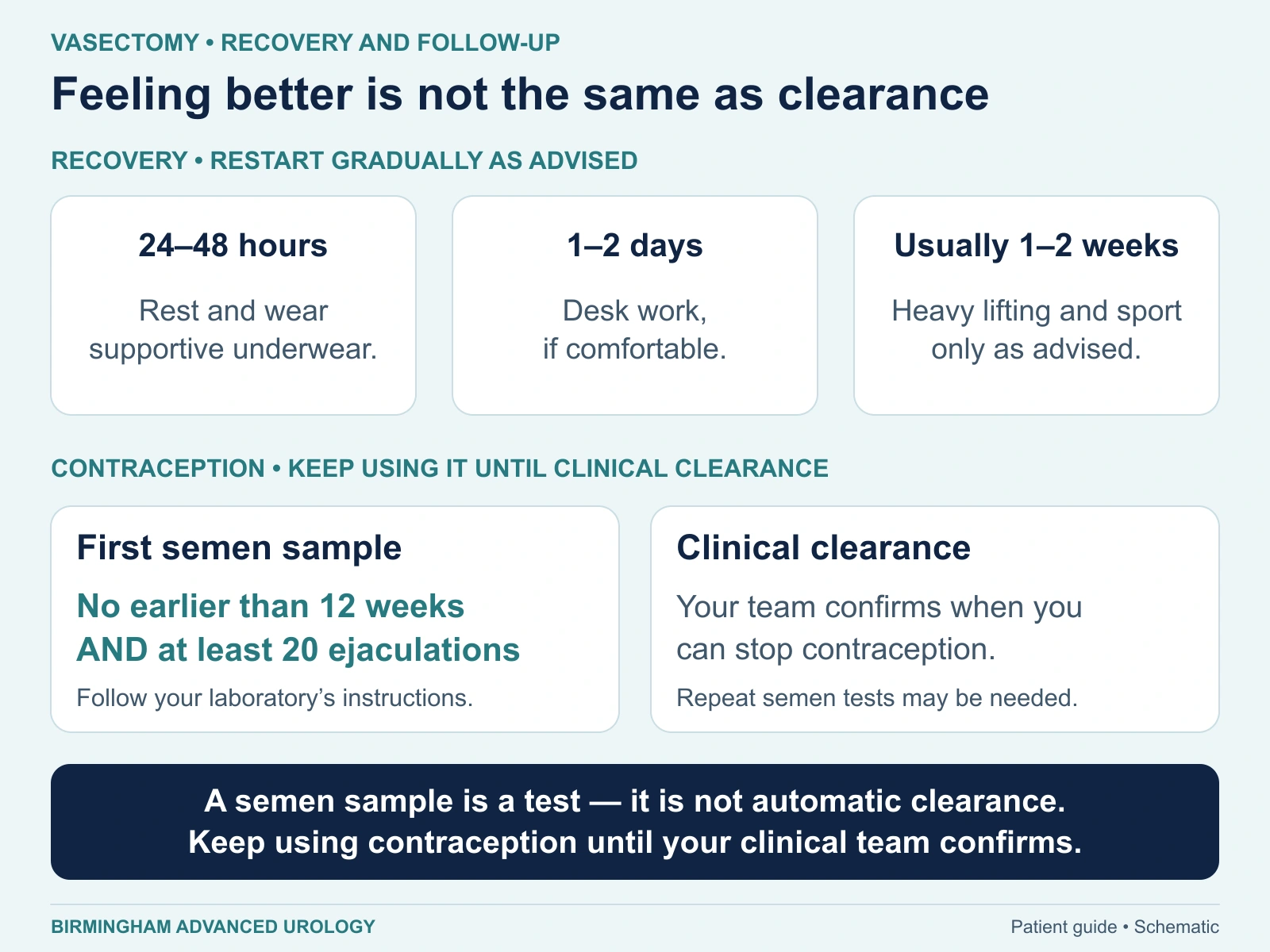
- The first 24–48 hours: take it easy and use supportive underwear as advised. A wrapped cold pack for short periods and appropriate simple pain relief may help.
- Work: desk work may be possible after 1–2 days if comfortable. Physical work may require longer.
- Exercise and lifting: avoid heavy lifting and sport for the period advised—usually 1–2 weeks—then restart gradually.
- Wound care: follow instructions about washing, dressings, baths and swimming; do not assume the opening has healed because it is small.
- Sex and masturbation: follow your team’s interval and wait for wound discomfort to settle. Continue contraception.
- Driving: restart only when you can control the vehicle and perform an emergency stop safely, and follow any anaesthetic and insurance advice.
When to seek help: contact your team, GP or NHS 111 promptly if pain or swelling is worsening or not improving, you develop a fever, the wound discharges pus or fluid, or a scrotal lump is getting larger. Severe sudden testicular pain or heavy bleeding needs urgent assessment.
The semen test: when can contraception stop?
Sperm already beyond the blockage can remain in the semen for a time. Feeling recovered, having a certain number of ejaculations or reaching a particular date does not confirm success.
UK laboratory guidance recommends the first post-vasectomy semen analysis no earlier than 12 weeks after the procedure and after at least 20 ejaculations. Both conditions matter. Follow your laboratory’s collection, abstinence and delivery instructions; it may specify a later appointment.
- One correctly tested sample with no sperm may be sufficient for clearance.
- Repeat tests are sometimes needed; sperm in the first sample do not automatically mean another operation is required.
- If very small numbers of non-moving sperm persist, a clinician may consider “special clearance”. UK guidance requires two qualifying samples and no moving sperm.
Keep using contraception until your clinical team confirms in writing that you can stop. Do not interpret a laboratory number or home test as clearance yourself. Without follow-up confirmation, success has not been established.
Sources: UK post-vasectomy semen-analysis guidance and NHS laboratory information.
Is vasectomy right for you?
Vasectomy may suit someone who is sure that they do not want future biological children. There is no need to rush. Consider how you might feel if your circumstances or relationship changed, and whether a reversible contraceptive option would better fit your needs.
Reversal is a more complex operation and does not guarantee pregnancy. Its outcome depends on several factors, including time since vasectomy. Sperm retrieval with IVF may be another option, but also involves treatment, cost and uncertainty. Neither should be treated as a reliable fallback. If future parenthood remains a possibility, discuss alternatives or sperm storage before deciding.
Tell the clinician about blood-thinning medicines, bleeding disorders, previous groin or scrotal surgery, testicular pain or a lump, and significant procedural anxiety. Do not stop prescribed medication without advice. These issues may change planning rather than automatically rule out vasectomy.
Information for GPs and referrers
A useful referral identifies the patient’s reason for seeking vasectomy and relevant factors for counselling and procedural planning. Include, where available:
- Medicines, especially anticoagulants or antiplatelets, allergies and bleeding disorders.
- Previous inguinal, scrotal or testicular surgery.
- Relevant examination findings, including difficulty feeling the vas, a lump or other scrotal abnormality.
- Existing scrotal pain and significant procedure or needle anxiety.
Consultation covers permanence, alternatives, consent, anaesthetic planning, recovery and the semen-testing pathway. Self-pay patients can enquire directly. Insured patients should check referral, authorisation and procedure-exclusion terms with their insurer before booking.
Common questions
Does a no-scalpel vasectomy hurt?
Local anaesthetic helps keep you comfortable. The injection may sting and pressure or pulling can be felt. Tell the team if you feel pain. An ache afterwards is common; worsening or persistent symptoms need advice.
Is it more effective than a conventional vasectomy?
The contraceptive effectiveness is similar. No-scalpel access can reduce some short-term complications. The method used to block the tubes and follow-up semen testing remain important.
Is “no-needle” the same as “no-scalpel”?
No. No-scalpel describes skin access. No-needle describes one way of delivering local anaesthetic, using a pressurised device. It is not automatically part of a no-scalpel procedure; ask what is planned for you.
When can I stop using contraception?
Only when your clinical team confirms clearance. The first semen sample is generally no earlier than 12 weeks and after at least 20 ejaculations, but a sample is a test rather than automatic permission to stop contraception.
Will my erections or sex drive change?
Vasectomy does not reduce testosterone and is not expected to alter erections, sex drive or orgasm. Discomfort can affect sexual activity during recovery, and a small minority develop persistent pain that needs assessment.
When can I return to work and the gym?
Desk work may be possible after 1–2 days if comfortable. Avoid heavy lifting and sport for the interval your team advises, usually 1–2 weeks, and restart gradually. Physical jobs may need more time.
Can a vasectomy be reversed?
Sometimes, but it should be considered permanent. Reversal does not guarantee pregnancy and is not routinely NHS-funded. Consider reversible contraception if you are unsure about future children.
What does a private vasectomy cost?
Ask Yasmin’s team for an itemised quotation before booking. Confirm whether consultation, surgeon and hospital charges, semen analysis, repeat tests and aftercare are included. A consultation fee is not the same as the full procedure cost. See our current fees and insurance information.
Is vasectomy available on the NHS?
NHS availability and waiting times vary locally. Your GP or local sexual-health service can advise about the pathway in your area. Private assessment offers another route to discussing suitability and treatment arrangements.
Private appointments
Discuss your options with Mr Shahzad
Mr Syed Ali Shahzad is a Consultant Urological and Robotic Surgeon (GMC 6071731). A consultation provides time to discuss your circumstances, examination findings, benefits, risks and alternatives before making a decision.
For appointments, availability and quotations, contact Yasmin Khan, his secretary:
- Telephone: 07866 009874
- Email: Yasmin.Khan@hcaconsultant.co.uk
Request a vasectomy consultation
Related information: Men’s health · Appointments and referral FAQs · Fees and insurance
Sources and further reading
- BAUS: Vasectomy patient information.
- NHS: Recovery after vasectomy and possible complications.
- Cochrane: Scalpel versus no-scalpel access (2014).
- Hancock and colleagues: UK laboratory guidelines for post-vasectomy semen analysis (2016); current NHS laboratory implementation.
- AUA Vasectomy Guideline Part I (2026) and AUA discussion of the updated recommendations.
This guide provides general information, not an individual recommendation. Risk estimates vary between studies and are not a clinic-specific guarantee. Follow your own clinical team’s procedure, aftercare and laboratory instructions.