

Finding a swelling near a testicle, or hearing that a varicocele might affect your fertility, can be unsettling. The reassuring starting point is that varicoceles are common, and many men who have one father children without treatment.
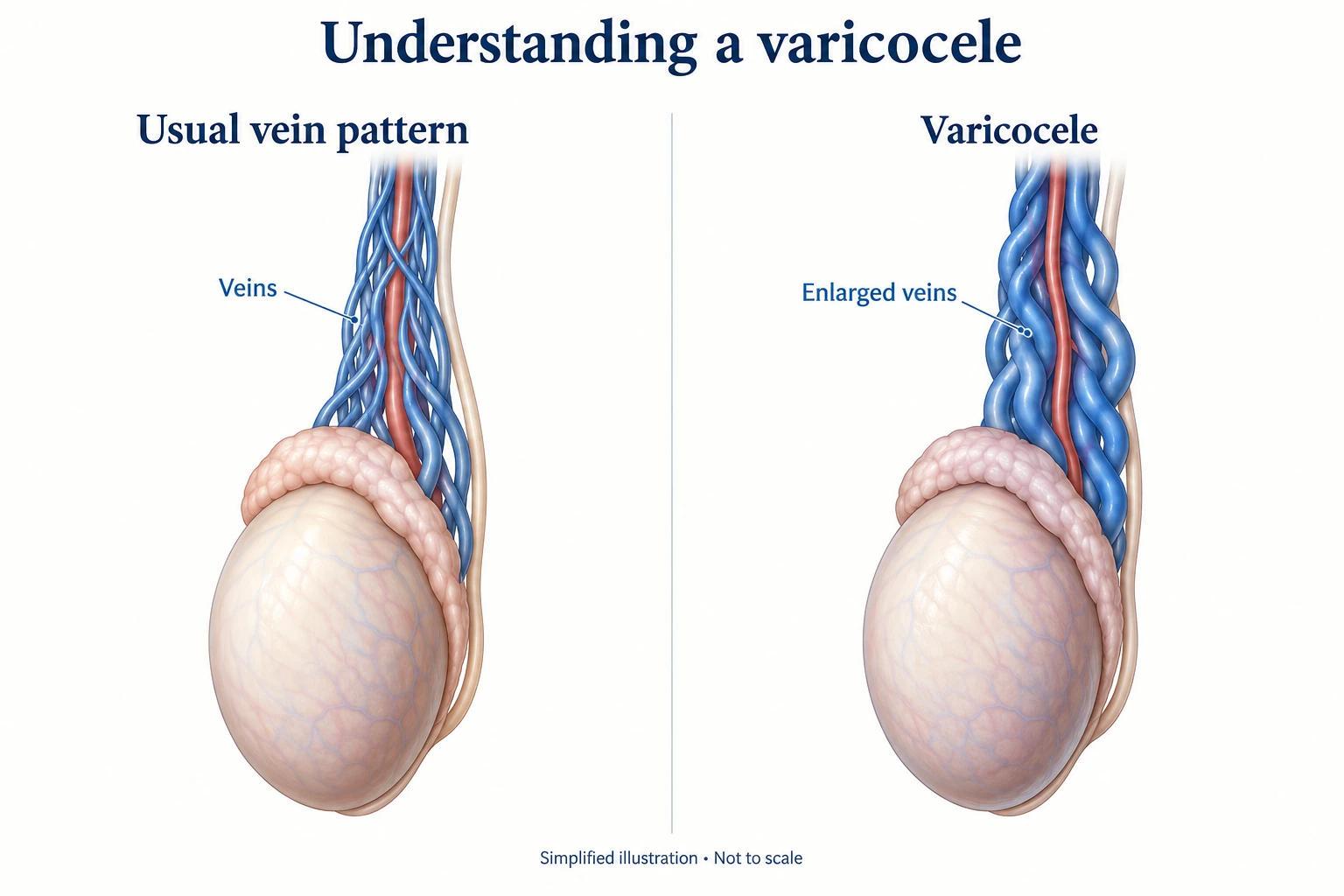
A varicocele is an enlargement of the veins around and above a testicle, inside the scrotum. These veins form a network called the pampiniform plexus. You can think of a varicocele as a similar problem to varicose veins in the legs, occurring in a different part of the body. It affects roughly 15 in every 100 men. [1]
Why does a varicocele develop?
Veins carry blood back towards the heart. Small one-way valves help prevent it flowing backwards. When drainage is inefficient, blood can collect in the veins around the testicle, making them wider and more winding. Valve function, the arrangement of the veins and pressure within them can all play a part. There is not always one identifiable cause. [1]
Varicoceles are more common on the left, largely because the left testicular vein follows a different drainage route through the abdomen. They can also affect both sides. The underlying issue is usually how the veins drain; it is not something a person has knowingly caused. [2]
They often become apparent around puberty, when the testicles are growing. [3] An unusual new swelling still needs assessment. A varicocele that develops suddenly, remains full when lying down, or occurs only on the right may prompt a clinician to look for another cause of impaired drainage. This does not mean that every right-sided varicocele is dangerous or needs a CT scan. [4]
How can it affect sperm production?
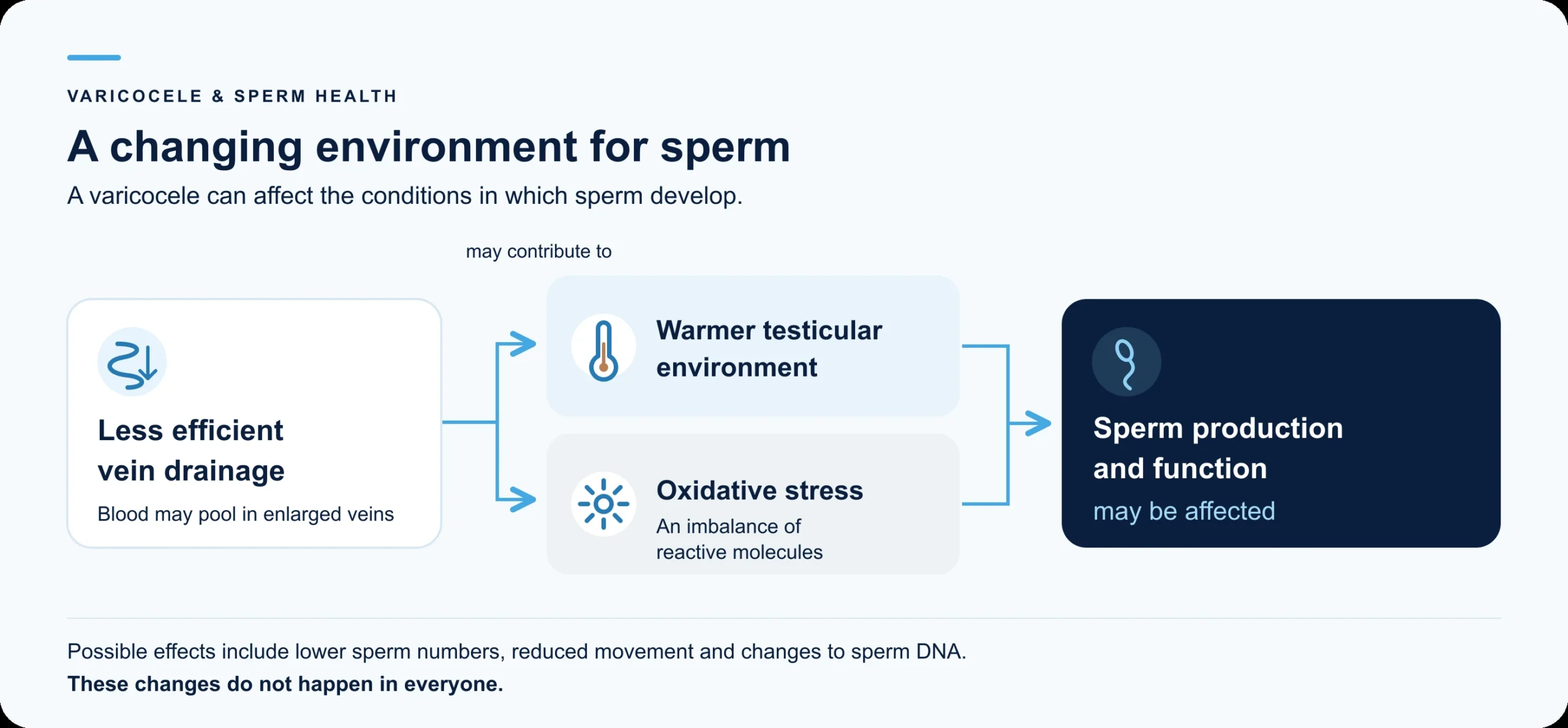
Spermatogenesis simply means making sperm. This happens in tiny tubes inside the testicles. The testicles normally work a little cooler than the rest of the body, and the surrounding blood vessels help regulate their temperature. A varicocele can disturb that environment. [2]
Possible effects include increased warmth, changes in oxygen delivery and oxidative stress: an imbalance between reactive molecules and the body’s protective systems. Some men develop fewer sperm, poorer sperm movement or changes in sperm shape. Sperm DNA, the genetic material inside each sperm, can also be affected. The mechanisms are complex and not fully understood. [5]
What might you notice?
Many varicoceles cause no symptoms. Others produce a dragging ache, heaviness or a soft cluster of veins above the testicle. Discomfort often becomes more noticeable after standing or activity and eases when lying down. Some men first discover a varicocele during fertility investigations. A persistent lump or pain deserves examination rather than self-diagnosis. [6]
How is it assessed?
Your clinician will ask about discomfort, previous treatment and plans for having children, then examine you standing and lying down. You may be asked to bear down briefly to make the veins easier to feel. Ultrasound can help when the examination is uncertain, measure testicular size or assess other scrotal findings. [6]
If fertility is a concern, a semen analysis checks sperm numbers, movement and shape. These are useful clues, but a result is not a simple fertile-or-infertile verdict. An abnormal test is usually repeated because results vary. NICE advises repeating it ideally after three months, with earlier confirmation if sperm are absent or very severely reduced. Hormone blood tests may be appropriate when abnormalities persist. [7]
Does every varicocele need treatment?
No. Observation is reasonable when there is no troublesome pain or evidence that testicular function is affected. [8] Supportive underwear and suitable simple pain relief may help mild aching. A clinician or pharmacist can advise what is safe for you. Persistent pain should be assessed for other causes before attributing it to the veins. [9]
In teenagers, follow-up focuses on testicular growth and symptoms. Treatment may be offered for a persistently smaller affected testicle, confirmed over time; operating on every teenager to prevent possible future infertility is not justified. [5]
When might repair be helpful?
Treatment is most often discussed for ongoing troublesome pain, concerns about testicular growth, or fertility problems with an appropriate combination of examination and semen findings.
For fertility, NICE’s March 2026 guidance recommends considering surgical or radiological treatment when a varicocele is detected on physical examination, semen parameters are reduced and the couple is trying to conceive naturally. The partner’s fertility factors also matter. [10]
A small varicocele seen only on ultrasound is not, by itself, a reason for fertility surgery. Repair is also not routinely advised for fertility when semen results are normal. [4]
What does treatment actually do?
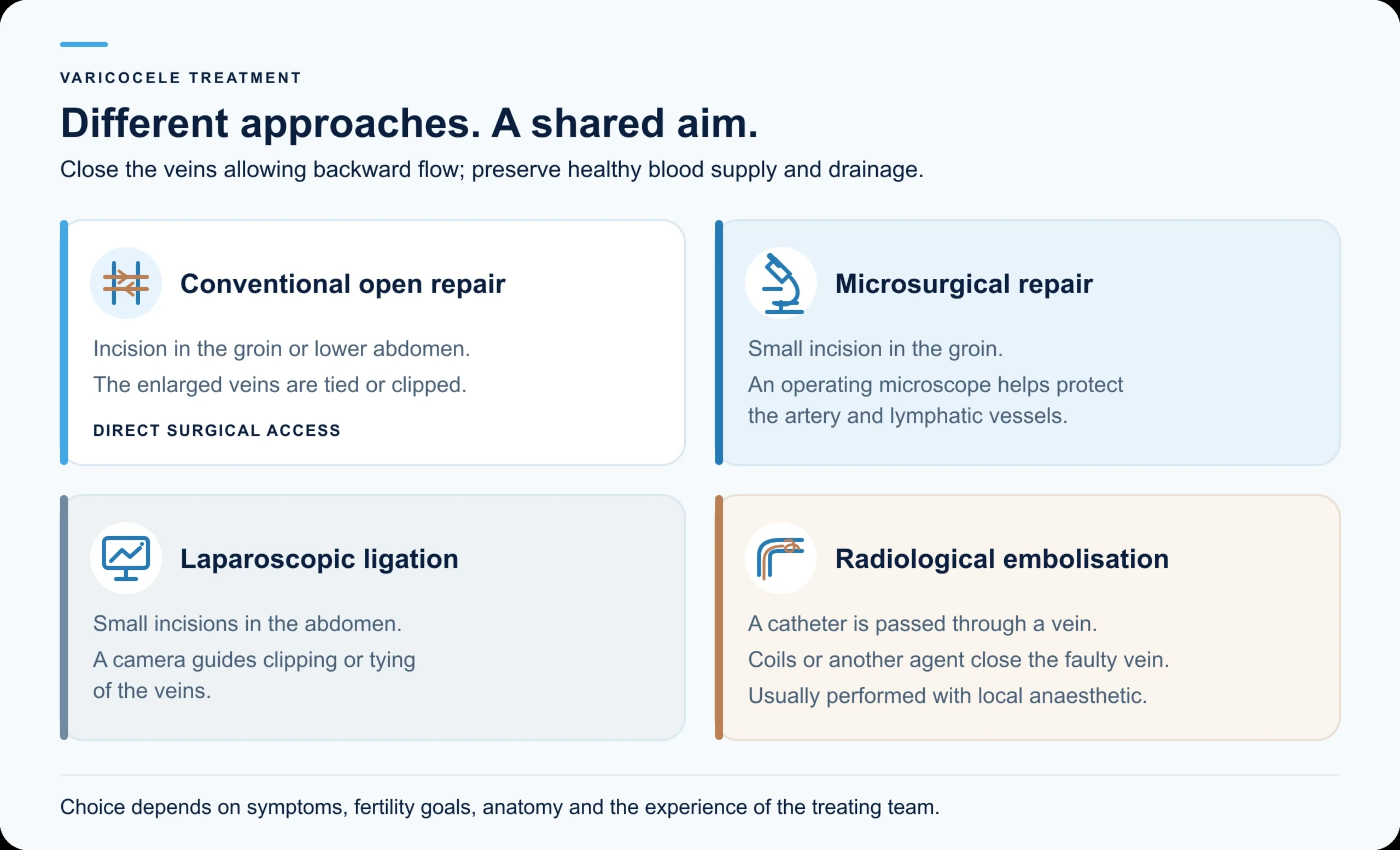
All the main treatments aim to stop backward flow through the problematic veins. Blood then drains through other available veins. The testicle remains in place, and the aim is to preserve its blood supply and the tube carrying sperm. [11]
Surgical repair
There are several ways to reach and close the affected veins. Microsurgical and laparoscopic repair are both forms of surgery.
Conventional open surgical repair
The surgeon reaches the veins through an incision in the groin or lower abdomen and ties or clips the veins responsible for the varicocele. This is called ligation. The exact route depends on the technique. Surgery is usually performed under general anaesthesia, and many patients go home the same day.
This is an established treatment, but without an operating microscope the smallest vessels can be harder to distinguish. Ask which structures will be preserved and what the surgeon’s own results show. [12]
Microsurgical repair
Microsurgical varicocelectomy is an open operation performed through a small incision in or just below the groin, using an operating microscope. The magnified view helps the surgeon identify the abnormal veins while protecting the testicular artery, the sperm-carrying tube and small lymphatic vessels that drain tissue fluid. The term subinguinal means the incision is just below the groin canal. [2]
Evidence favours microsurgical approaches for lower recurrence and fewer hydroceles than some other operations. A hydrocele is a collection of fluid around the testicle. Microsurgery requires specialist training and experience; magnification does not eliminate every risk. [5]
Laparoscopic ligation
Laparoscopy uses small abdominal incisions, a camera and fine instruments. The surgeon clips or ties the testicular veins higher up inside the abdomen. It requires a general anaesthetic.
Recovery includes healing of the abdominal wounds, and some people experience temporary shoulder-tip discomfort from the gas used during the operation. Alongside the usual risks of varicocele surgery, laparoscopy carries uncommon risks associated with entering the abdomen, including injury to bowel or major blood vessels. A small minority need conversion to an open operation. [13]
Radiological embolisation
Embolisation is performed by an interventional radiologist, a doctor who treats conditions using imaging to guide small instruments inside the body. It usually involves local anaesthetic at a small puncture site in the neck or groin; sedation may also be offered.
A thin tube called a catheter is guided through a vein towards the testicular vein. X-ray imaging and contrast dye show the anatomy and backward flow. The radiologist closes the problematic vein using coils, a blocking agent or a combination. The catheter is then removed. [14]
This avoids an abdominal or groin surgical incision and is usually a day-case procedure. Return to light activities is often quicker than after an operation, although the treating team will give individual advice. It can also be useful when a varicocele has returned after surgery. [11] [15]
Limitations include occasional difficulty reaching or completely blocking the vein because of its anatomy. Risks include bruising, temporary discomfort, inflammation, a reaction to contrast dye and exposure to a small amount of radiation. Rarely, a coil or other material moves from its intended position. The varicocele may persist or recur. [14] [15]
Which approach is best for me?
There is no single answer for everyone. A useful discussion brings together the reason for treatment, the anatomy, any previous procedures, recovery needs and the experience of the surgeon or radiologist.
Microsurgical repair has advantages over some other operations, but evidence does not establish that surgery always gives better fertility outcomes than embolisation. NICE’s evidence review found no important demonstrated difference between surgical and radiological treatment overall. The choice should follow an informed discussion of both options. [16]
Can repair improve fertility?
For appropriately selected men, treatment may improve semen quality and the chance of pregnancy. However, there are three different outcomes: improving a semen result, achieving a pregnancy and having a baby. Evidence of benefit is not equally strong for all three.
A Cochrane review found that treatment may increase pregnancy rates, while the effect on live birth remained uncertain. Some men show little or no semen improvement, and some couples still need assisted conception. Repair cannot guarantee natural conception. [17]
The timing matters too. The fertility team should consider both partners, including age, ovarian reserve and how long you have been trying. Waiting for a possible response to repair may not suit every couple. Current NICE guidance does not establish a routine role for varicocele treatment before assisted conception because suitable trial evidence is lacking. [16]
If no sperm are found in the semen, called azoospermia, specialist investigation is needed. When this reflects severely impaired sperm production rather than a blockage, evidence for varicocele repair is uncertain. It should not be presented as a reliable way to restore sperm or avoid fertility treatment. [4]
When will we know whether it has helped?
Making and maturing a new batch of sperm takes about three months. Fertility changes therefore cannot be judged in the first few days or weeks. [18]
A repeat semen analysis is commonly arranged around three months after treatment, with further review according to the results. Mild bruising and discomfort can occur during early recovery. After surgery, heavy lifting and strenuous exercise are often restricted for two to three weeks. Follow your team’s advice about work, driving, exercise and sex. The visible veins may take time to become less prominent and may never disappear completely. [8]
Pain may improve after treatment, but relief is not guaranteed. A persistent ache deserves reassessment rather than an assumption that more vein treatment is necessarily the answer. [9]
Questions worth bringing to your appointment
- Is the varicocele likely to explain my symptoms or semen results?
- Would observation be reasonable, and what should follow-up involve?
- What is the realistic goal of treatment in my case?
- Why do you recommend this approach, and is embolisation or microsurgery an alternative?
- How would repair fit with our wider fertility plan?
- When will we reassess, and what would happen if it has not helped?
After a procedure, contact the treating team promptly for increasing pain or swelling, fever, wound redness or discharge, or another unexpected change. [12]
A good treatment decision starts with understanding what the varicocele means for you. An assessment can connect the examination and test results with the outcome that matters most: comfort, testicular health or the chance of having a child.
Patient information updated 26 September 2026. Evidence sources checked on that date. This guide supports a discussion with your clinician and does not replace individual assessment.
Sources and further reading
Clinical sources checked on 26 September 2026. The numbered links throughout the article lead to the sources listed below.
- Guy’s and St Thomas’ NHS: varicocele embolisation overview
- Johns Hopkins Medicine: varicocele
- Manchester University NHS: varicocele in young people
- AUA/ASRM: male infertility guideline, amended 2024
- EAU: male infertility guideline, 2026
- CIRSE: varicoceles
- NICE NG257: investigations and management strategies, 2026
- BAUS: microsurgical varicocele ligation leaflet
- Mayo Clinic: varicocele diagnosis and treatment
- NICE NG257: recommendation 1.28.1, March 2026
- Chelsea and Westminster NHS: varicocele embolisation
- West Suffolk NHS: open clipping or tying of varicocele
- Cambridge University Hospitals NHS: laparoscopic ligation
- South Tees NHS: varicocele embolisation
- King’s College Hospital NHS: varicocele embolisation
- NICE NG257: rationale and impact, varicocele
- Cochrane: surgery or radiological treatment for varicoceles
- MyHealth Devon NHS: diagnostic semen analysis
- NHS: testicle lumps and swellings
Original educational illustrations. Anatomy and treatment are simplified; the diagrams are not procedural instructions.