

Your health · Bladder care
Blood in urine (haematuria): causes, tests and treatment
Seeing blood in your urine can be unsettling, especially when it happens without warning. Haematuria means blood in the urine. It is a finding to investigate, rather than a diagnosis in itself. Infection, stones, prostate problems and kidney conditions are possible causes. Sometimes no cause is found; bladder or kidney cancer is another possibility that assessment aims to exclude.
This guide explains haematuria in adults, which investigations may help and how treatment depends on the cause. If you can see blood, or think you can, ask for an urgent GP appointment or contact NHS 111—even if it happens once, is painless or has already stopped. NHS advice on blood in urine.
When blood in urine needs urgent help
Emergency help
Go to A&E for inability to pass urine, clots with a painful full bladder, heavy ongoing bleeding or severe pain. Call 999 if you collapse, become confused, have difficulty breathing or are too unwell to travel safely. Clots can obstruct the bladder and may need catheter drainage and washout in hospital. BAUS guidance on significant bleeding and NHS sepsis advice.
Urgent GP or NHS 111 advice
Arrange urgent advice for any suspected visible blood. Fever or shaking chills with urinary symptoms, pain in the side or back, or vomiting also needs urgent assessment. Blood after an injury needs prompt medical assessment; a significant injury or severe symptoms warrants A&E. If you are becoming very unwell, use emergency care. NHS kidney infection advice.
Blood found on a urine test
If your urine looks normal but a test detects blood, arrange a clinical review of the result, symptoms and medical history. The urgency and next tests depend on that assessment. A routine private appointment must not delay urgent care.
Visible and non-visible haematuria
- Visible haematuria: blood changes the appearance of urine, which may look pink, red or brown. It is also called macroscopic haematuria.
- Non-visible haematuria: blood is detected on testing even though the urine may look normal. You may hear the terms microscopic or dipstick haematuria.
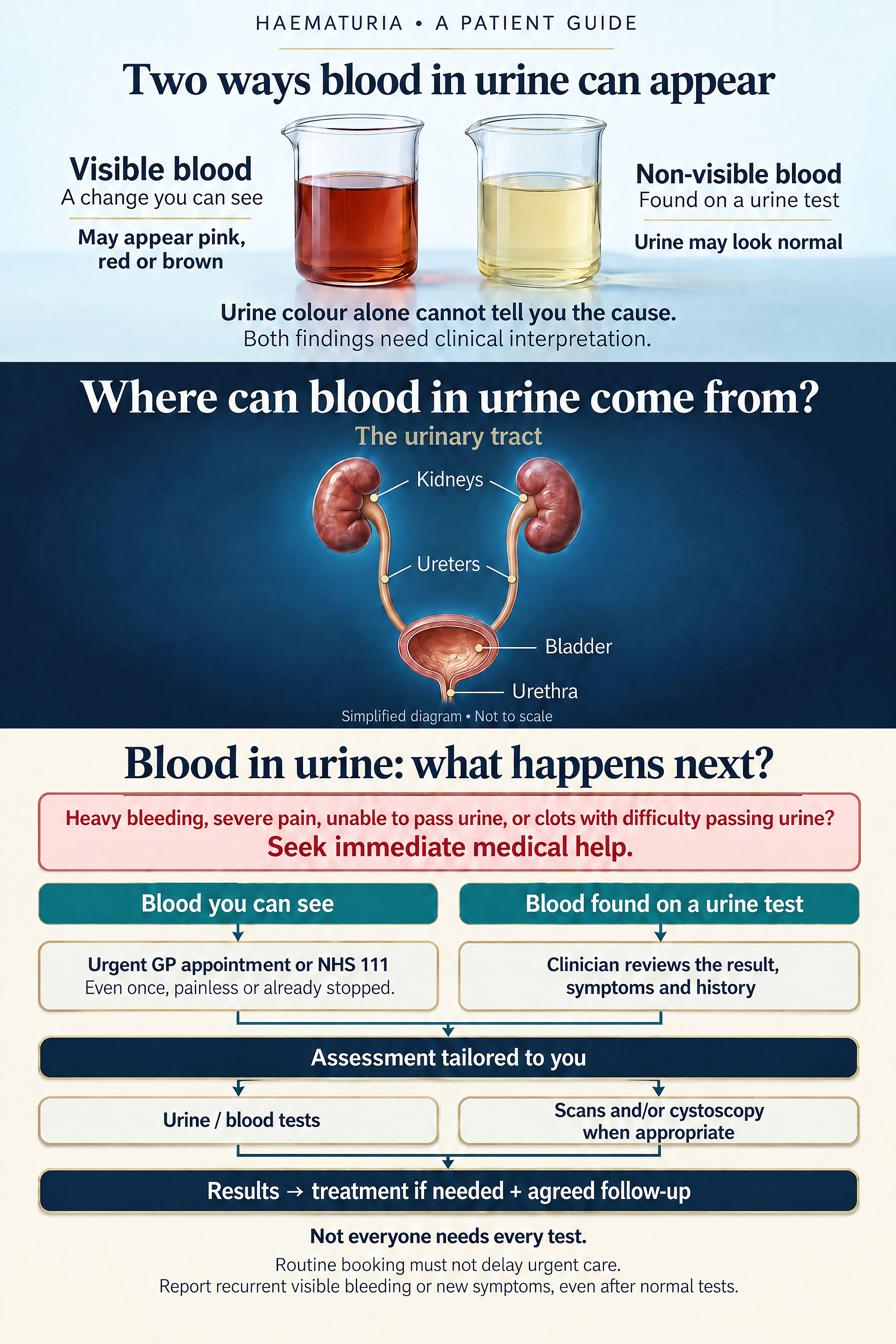
Read this infographic as text
Visible and non-visible blood
Visible blood may make urine pink, red or brown. Non-visible blood is found on a urine test, even when the urine looks normal.
Appearance alone cannot establish the cause. A clinician interprets the finding alongside your symptoms and history; the illustration is not a colour chart for self-diagnosis.
Where the blood can come from
Two kidneys make urine. Each drains through its own ureter into the bladder. Urine leaves the bladder through the urethra.
Bleeding can arise anywhere along this route or from the kidney filtering tissue. The prostate can also be a source of bleeding in people who have a prostate; it is not shown in this simplified diagram.
What happens next
Emergency symptoms such as heavy ongoing bleeding, severe pain, inability to pass urine, or clots with a painful full bladder need immediate medical help. Go to A&E. Call 999 if you collapse, become confused, have difficulty breathing or are too unwell to travel safely.
Visible or suspected blood needs urgent GP or NHS 111 advice, even once, without pain or after it has stopped. Fever or shaking chills with urinary symptoms, pain in the side or back, or vomiting also needs urgent assessment.
Blood found on a urine test needs a clinician to review the result, your symptoms and medical history. The urgency and investigation plan depend on that assessment.
Assessment is tailored to you. Selected investigations may include urine and blood tests, scans and cystoscopy. Not everyone needs every test.
The results guide treatment if needed and an agreed follow-up plan. Report recurrent bleeding or new urinary symptoms even after normal tests. Urgent symptoms need urgent care at any stage; routine private booking must not delay urgent care.
In UK practice, NICE advises further evaluation of a dipstick result of 1+ or more; microscopy is not required to confirm a positive dipstick. For isolated non-visible blood without protein in the urine, two positive results out of three can establish persistence. A single trace result may not be significant, but symptoms and the wider clinical picture matter. Do not wait for repeat samples before seeking advice about visible blood. NICE guidance on haematuria testing.
Could the colour be caused by something else?
Beetroot and some medicines can change urine colour. Menstrual, vaginal or rectal bleeding can also be mistaken for urinary bleeding. Dehydration can make urine dark yellow or amber, but does not by itself explain blood. A clinician can help establish whether blood is present and where it comes from; one urine test does not always settle the cause. NHS guidance.
Where can the blood come from?
The kidneys make urine. It travels down two tubes called ureters to the bladder, then leaves through the urethra. In men, the urethra passes through the prostate. Bleeding can arise at different points along this route, or from the kidney’s filtering tissue.
Pain may suggest a stone, infection or blockage, but it does not rule out other causes. Painless bleeding also needs assessment. The amount, colour and presence or absence of pain cannot reliably identify the cause on their own.
What causes blood in urine?
Urinary infection
A bladder infection may cause burning, urgency or frequent urination alongside blood. Kidney infection can cause fever and pain in the side or back; prostatitis can also produce urinary symptoms in men. Blood alone does not establish an infection. If bleeding persists or returns after treatment, it needs reassessment. NHS information on UTIs.
Kidney, ureteric or bladder stones
Stones can irritate the urinary tract. A stone moving down a ureter may cause severe pain in waves, often travelling towards the groin, although some stones cause little discomfort. Fever with possible stone symptoms can signal infection behind a blockage and needs urgent assessment. Read about kidney stone assessment and treatment.
Enlarged prostate
An enlarged prostate can bleed and may coexist with a weak stream, difficulty starting or incomplete emptying. Other causes still need consideration before bleeding is attributed to benign prostate enlargement. Prostate cancer can occasionally cause bleeding too; a prostate examination and discussion of PSA testing may be appropriate.
Bladder, kidney and other urinary tract cancers
Bladder cancer may cause intermittent, painless bleeding. Kidney cancer and less common cancers of the kidney drainage system or ureter can also cause blood. Smoking, age, some occupational chemical exposures and previous pelvic radiotherapy affect risk. Bleeding that stops still deserves assessment. EAU information on bladder cancer risk factors.
Medical kidney conditions
Inflammation of the kidney filters, including conditions such as IgA nephropathy, can cause haematuria. Protein in the urine, high blood pressure or reduced kidney function may provide additional clues. A kidney physician, or nephrologist, may lead care, sometimes alongside a urologist. NHS information on glomerulonephritis.
Medicines, procedures, injury and less common causes
Blood-thinning medicines can contribute to bleeding. Recent instrumentation, surgery, injury and strenuous exercise may be relevant, as can previous radiotherapy or cyclophosphamide treatment. Less common causes include schistosomiasis after freshwater exposure abroad, sickle cell conditions, clotting disorders, ketamine-related bladder injury and urinary tract endometriosis. Mention relevant travel, treatment and drug history to your clinician. BAUS assessment guidance.
After a procedure, follow the specific discharge instructions: expected bleeding varies with the procedure. New visible blood should not simply be attributed to exercise, and ongoing or worsening bleeding needs advice.
Does age or sex change the assessment?
Age, smoking history, symptoms, persistence and whether blood is visible all influence the investigation plan. Infection, stones and kidney inflammation can occur in younger adults; urinary tract cancer becomes more likely with age. Age alone is not a reason to dismiss visible blood.
In women, infection or menstrual contamination may explain a finding, but recurring symptoms or bleeding should not repeatedly be attributed to infection, periods or menopause without reassessment. If bleeding is vaginal after menopause, that also needs a GP check, even once. NHS advice on postmenopausal bleeding.
In men, prostate enlargement can coexist with a separate bladder or kidney problem. A PSA test does not replace haematuria assessment. This is an adult guide: children need a separate assessment, and pregnancy affects the choice of investigations and treatment.
What if I take blood thinners?
Warfarin, apixaban, rivaroxaban, aspirin and similar medicines can contribute to haematuria, but they do not remove the need to consider an underlying cause. Assessment is based on your symptoms and risk factors, rather than assuming the medicine explains the bleeding.
Do not stop prescribed anticoagulant or antiplatelet treatment yourself. Seek medical advice so the risks of bleeding and clotting can be considered together. NHS haematuria referral guidance.
When does NICE recommend an urgent cancer referral?
NICE recommends a suspected-cancer pathway referral for:
- People aged 45 and over with unexplained visible haematuria without a UTI, or visible blood that persists or returns after successful UTI treatment. This applies to possible bladder or kidney cancer.
- People aged 60 and over with unexplained non-visible haematuria plus either pain when passing urine or a raised white-cell count on a blood test, for possible bladder cancer.
NICE also advises considering non-urgent bladder-cancer referral for people aged 60 and over with recurrent or persistent unexplained UTIs. These criteria guide urgency; they are not a diagnosis of cancer or a reason for younger people to ignore symptoms. NICE NG12 referral recommendations.
The NHS suspected-cancer pathway aims to diagnose or rule out cancer within 28 days of urgent referral. This is a service standard, not a promise that every result will be ready on a particular date. NICE kidney cancer quality standard.
What investigations might I need?
The aim is to assess the relevant parts of the urinary tract while avoiding tests unlikely to help. Your symptoms, age, previous results, kidney function and personal circumstances determine the plan. Not everyone needs every test.
Consultation, urine and blood tests
Your clinician asks when bleeding began, whether you have clots or pain, and about infection, smoking, medicines, previous treatment, work and travel. Examination may include the abdomen, blood pressure and, where appropriate, a prostate or pelvic examination.
Urine tests can help assess infection and protein leakage. Blood tests may check kidney function and anaemia. A urine albumin-to-creatinine ratio (ACR) helps assess possible kidney disease. A PSA test may be discussed where appropriate; infection and recent procedures can affect interpretation. BAUS initial assessment.
Ultrasound and CT urography
Ultrasound assesses the kidneys and bladder without ionising radiation. CT urography, also called a CT urogram, uses X-rays and usually an injected contrast agent to examine the upper urinary tract in greater detail. The choice depends on the suspected cause and your circumstances; visible blood does not automatically mean everyone needs CT.
Tell the team about possible pregnancy, kidney problems and any previous reaction to injected contrast. A scan and cystoscopy answer different questions: a normal scan does not always remove the need to inspect the bladder. NICE imaging recommendations.
Flexible cystoscopy
A thin flexible camera passes through the urethra to inspect the bladder lining. Local anaesthetic gel is usually used, and fluid gently fills the bladder to improve the view. The examination commonly takes about 10–15 minutes, although the visit takes longer. It may feel uncomfortable and can be painful for some people; discuss concerns or previous difficult experiences beforehand. NHS explanation of cystoscopy.
At Birmingham Advanced Urology, this examination uses a single-use flexible cystoscope—a new scope for each patient. Walk-in, one-stop flexible cystoscopy is possible on most occasions, so clinical assessment and cystoscopy can often take place during the same visit, subject to clinical suitability and availability. Please contact Yasmin before travelling to confirm the clinic location and whether same-visit cystoscopy can be offered.
You can usually go home afterwards. Mild burning or a small amount of blood may occur for a few days. Follow the aftercare instructions and seek urgent advice for fever, worsening bleeding, severe pain or difficulty passing urine. If you cannot pass urine, particularly with a painful swollen lower abdomen, seek emergency help. NHS cystoscopy aftercare. Initial findings can often be explained at the visit; biopsy, laboratory or scan reports may take longer. Read about cystoscopy at BAU.
Urine cytology
In selected cases, cells in a urine sample are examined for signs of cancer. Cytology is more useful for some higher-grade cancers; a negative result does not rule out cancer and cannot replace cystoscopy when bladder inspection is needed. EAU diagnostic guidance.
How is haematuria treated?
Treatment addresses the cause, rather than urine colour alone. Your clinician should explain the options, their benefits and risks, and the follow-up plan.
Infection
Antibiotics may be appropriate when infection is diagnosed or strongly suspected; urine results help guide treatment. Blood alone is not a reason for repeated antibiotic courses. Persistent or recurring bleeding needs reassessment. NHS UTI treatment.
Stones
Some small stones can be observed with symptom relief. Others need shockwave treatment, ureteroscopy with laser treatment or a procedure through the back for larger kidney stones. Size, position, obstruction and infection influence the choice. An infected obstructed kidney may need urgent drainage before definitive stone treatment. NHS stone treatment and EAU guidance on obstructed kidneys.
Prostate-related bleeding
Once other causes have been assessed, prostate-related bleeding and urinary symptoms may be managed with medicines or a procedure. A procedure such as TURP, HoLEP or Aquablation may be discussed where clinically suitable; selection depends on prostate size, obstruction, bleeding and your priorities. These procedures are not interchangeable treatments for all haematuria. NHS treatment for an enlarged prostate.
Medical kidney disease
Treatment depends on the underlying kidney condition and may include blood-pressure management, measures to protect kidney function and specialist medicines. Nephrology assessment helps decide what is appropriate. NHS glomerulonephritis treatment.
Bladder or kidney cancer
A bladder abnormality may need telescopic removal or sampling, called TURBT, to establish the diagnosis and depth of involvement. Depending on the results, treatment may include medicines placed in the bladder, further surgery, radiotherapy or systemic treatment. Kidney cancer options may include surveillance in selected cases, partial or complete kidney removal, ablation or drug treatment. A specialist multidisciplinary team helps plan care according to cancer type, stage and fitness. NHS bladder cancer treatment and kidney cancer treatment.
Heavy bleeding or clot retention
Hospital care may involve a catheter, bladder irrigation or clot removal. Continuing bleeding sometimes requires a procedure to find and control its source. Blood-thinning treatment may need adjustment by the treating team. These are urgent-care decisions, not measures to attempt at home. BAUS visible haematuria guidance.
What if the tests are normal?
Normal investigations can be reassuring, although a cause is not always identified. Ask what has been checked, whether any results remain outstanding and what follow-up is appropriate. Report further visible bleeding or new urinary symptoms, even after a normal assessment.
For persistent non-visible haematuria without proteinuria, NICE advises annual monitoring of urine blood, urine protein or albumin, kidney function and blood pressure for as long as the finding persists. New protein leakage, worsening kidney function or a change in symptoms may require reassessment. NICE follow-up recommendations.
Common questions about blood in urine
Is blood in urine without pain still a concern?
Yes. Bleeding can be intermittent, and an absence of pain does not establish the cause. Ask for urgent GP or NHS 111 advice even if the urine now looks normal.
Can a UTI explain it?
Yes, but persistent or recurring blood after successful treatment needs review. A previous UTI does not automatically explain a new episode.
Does blood in urine always mean cancer?
No. There are several non-cancerous causes. Assessment helps identify the cause and decide which tests are needed; population or clinic statistics cannot tell you your individual risk.
Will I definitely need a CT scan and cystoscopy?
No. The investigation plan depends on the type of bleeding, symptoms, risk factors and earlier results. Your clinician should explain why each recommended test would help.
Should I stop my blood thinner or drink lots of water?
Do not stop prescribed blood thinners without advice. Keep to your usual fluid guidance, especially if you have a fluid restriction. Extra water does not investigate or treat the underlying cause; inability to pass urine needs urgent care.
Haematuria assessment in Birmingham
Mr Syed Ali Shahzad, Consultant Urological and Robotic Surgeon, provides private urology care across Birmingham, Worcestershire and the West Midlands. BAU offers haematuria assessment and a one-stop bladder clinic. The team can confirm the appropriate location, tests and scheduling; some results or investigations require a separate visit.
The currently listed initial consultation fee is £200. Investigations, procedures and hospital charges are separate. Self-pay patients can book without a GP referral; insured patients should check referral and authorisation requirements with their insurer. Confirm the total expected costs before booking. BAU fees and insurance.
For appointments, contact Yasmin Khan, secretary to Mr Shahzad:
- Telephone: 07866 009874
- Email: Yasmin.Khan@hcaconsultant.co.uk
- Online: Request an appointment or send a WhatsApp enquiry
Bring a medication list and any previous urine, blood or scan reports. If possible, note when the bleeding occurred and whether it came with pain, clots or infection symptoms. Routine enquiries are not an emergency service.
This guide provides general information for adults and does not replace individual medical advice. The linked clinical sources support the information throughout the article.