
Prostate care

Enlarged Prostate Symptoms and BPH Treatment

Consultant-led assessment and treatment planning with Mr Syed Ali Shahzad, Consultant Urological and Robotic Surgeon.

Benign Prostatic Hyperplasia (BPH) Treatment in Birmingham

Benign prostatic hyperplasia (BPH) is the medical term for an enlarged prostate. It is the most common prostate condition, affecting more than half of men over 50 and the vast majority of men over 70. Mr Syed Ali Shahzad, Consultant Urological and Robotic Surgeon, is a specialist in BPH management and offers the full range of treatments, from medication to the latest minimally invasive procedures, at private hospitals across Birmingham.

What Is BPH?

The prostate gland surrounds the urethra (the tube through which urine passes) just below the bladder. As it enlarges with age, it can compress the urethra and cause a range of urinary symptoms. BPH is not cancer and does not increase the risk of prostate cancer, but it can significantly affect quality of life.

Symptoms of BPH

Symptoms are grouped into obstructive and irritative categories:

  • Weak or slow urinary stream
  • Difficulty starting to urinate (hesitancy)
  • Dribbling after urination
  • A sense of incomplete bladder emptying
  • Frequent urination, particularly at night (nocturia)
  • Sudden urge to urinate (urgency)
  • Urinary incontinence

Diagnosis

Assessment includes a discussion of symptoms using validated questionnaires (such as the IPSS), physical examination including a digital rectal examination, PSA blood test, urine flow rate measurement and bladder scan. Further investigations such as flexible cystoscopy or urodynamics may be recommended in some cases.

Treatment Options for BPH

Mr Shahzad believes in tailoring treatment to the patient’s symptoms, prostate size, anatomy, lifestyle and personal preferences. Options include:

  • Lifestyle modifications: Fluid management, reducing caffeine and alcohol, bladder training.
  • Medication: Alpha-blockers (relaxing the prostate muscle), 5-alpha reductase inhibitors (shrinking the prostate), or combination therapy.
  • UroLift: A minimally invasive procedure that lifts and holds the enlarged prostate tissue away from the urethra.
  • Rezum therapy: Steam ablation of prostate tissue, preserving continence and sexual function. A designated expert user procedure.
  • Aquablation therapy: Water-jet ablation guided by ultrasound and robotic precision, with excellent symptom relief and function preservation.
  • Green Light laser prostatectomy: Laser vaporisation of excess prostate tissue.
  • TURP (transurethral resection of the prostate): The traditional surgical gold standard for BPH.

Why Choose Mr Shahzad for BPH Treatment?

Mr Shahzad is a designated expert user of Rezum therapy and is trained in Aquablation, UroLift and Green Light laser prostatectomy. He is committed to selecting the treatment that best matches each patient’s anatomy, symptoms and life goals, particularly with regard to preserving sexual function and continence.

Book a BPH Consultation in Birmingham

No GP referral is required. Mr Shahzad is recognised by BUPA, AXA, AVIVA, Vitality, Cigna and WPA and welcomes self-pay patients. Book an appointment or contact us today.
Need urgent help?

If you are experiencing severe pain, heavy bleeding, inability to pass urine, fever with urinary symptoms or symptoms requiring urgent attention, seek urgent medical help through NHS 111, your GP, A&E or emergency services depending on severity.

Request a private appointment

About the author: This page is written and clinically reviewed by Mr Syed Ali Shahzad, a private consultant urologist in Birmingham. Book a private consultation to discuss your symptoms and treatment options.

Free patient guide

Comparing enlarged prostate treatments – patient guide

A seven-page comparison of observation, medicines, Rezūm, UroLift, Aquablation, TURP and GreenLight laser, including suitability and recovery questions.

Prepared by Birmingham Advanced Urology · Reviewed September 2026 · 7 pages

Download PDF

Mr Shahzad’s clinical approach

The procedure should follow the diagnosis

Similar urinary symptoms can arise from different combinations of prostate obstruction and bladder function. Treatment selection therefore considers symptom burden, urine flow, bladder emptying, prostate anatomy, medicines, sexual-function priorities and the recovery a patient can accommodate.

Illustrative care pathway

  1. Measure symptoms, flow and bladder emptying
  2. Assess prostate anatomy and exclude other causes
  3. Compare observation, medication and suitable procedures
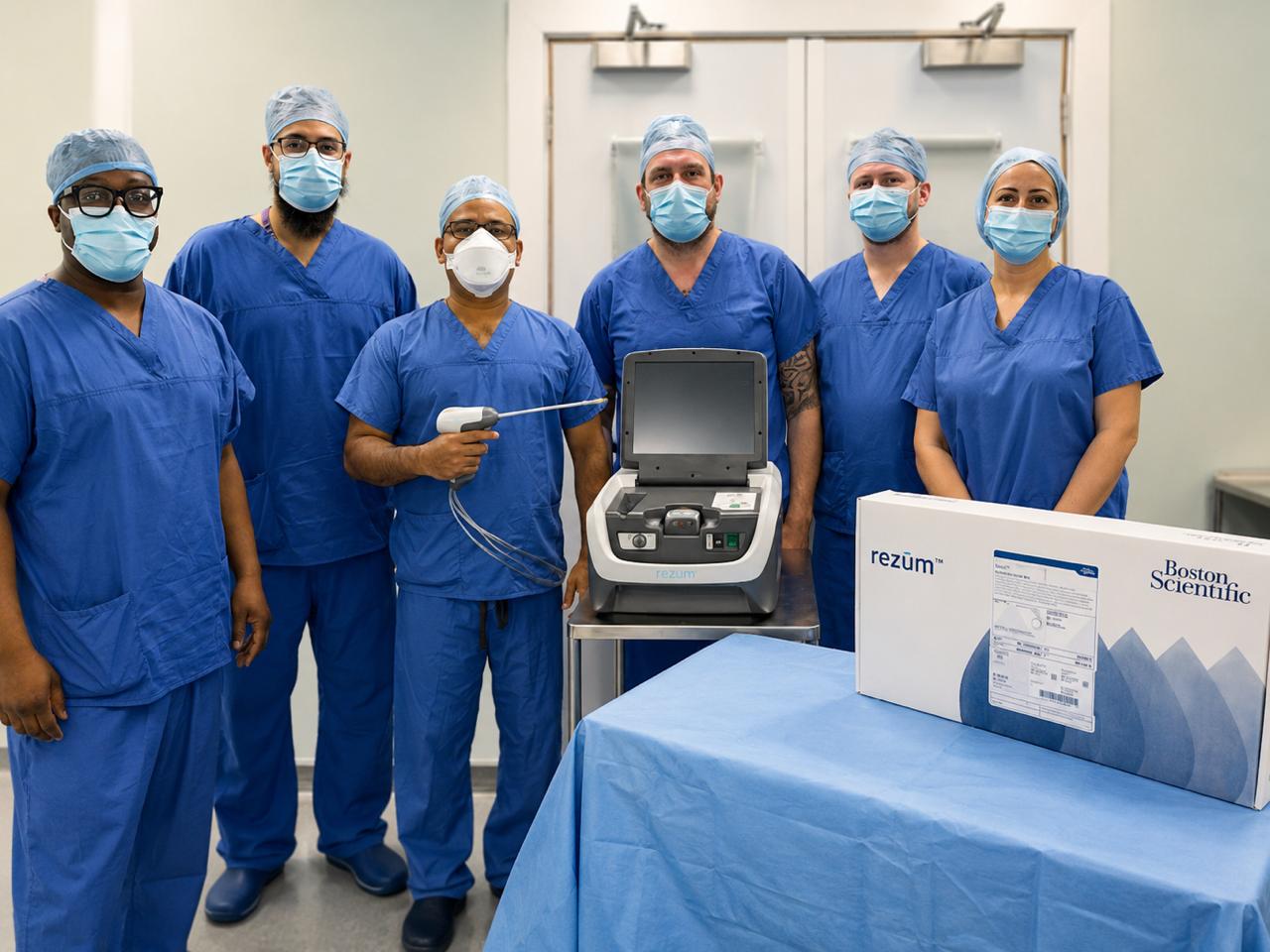
Mr Syed Ali Shahzad with the Rezum clinical team and treatment equipment
Mr Shahzad with the clinical team and treatment equipment used in prostate care.

Context: This is an illustrative pathway, not an individual patient case or personal medical recommendation. The sequence changes according to clinical findings and patient circumstances.

Patient decision guide

Choosing treatment for enlarged prostate symptoms

Treatment choice should reflect prostate anatomy, bladder emptying, symptom severity, sexual-function priorities and recovery preferences.

Who should seek assessment

Men troubled by weak flow, straining, urgency, frequency, night-time urination, retention or repeated infections should have the cause clarified.

Non-surgical options

Lifestyle changes, observation and medication may be reasonable when symptoms and complications allow.

Minimally invasive choices

Rezūm and UroLift may suit selected anatomy. Aquablation can be considered for suitable patients after prostate assessment.

Established surgical choices

TURP and GreenLight laser remain useful options for selected obstruction patterns, prostate sizes and clinical circumstances.

You do not need to choose a procedure before booking. Suitability and trade-offs are discussed after the relevant tests and imaging are reviewed.

Your care pathway

Enlarged prostate assessment and treatment pathway

The right treatment depends on symptom burden, bladder emptying, prostate anatomy, priorities and previous medication.

1

Understand symptoms

Review urinary flow, urgency, frequency, night-time urination and impact on daily life.

2

Measure flow and emptying

Urine testing, uroflowmetry and a post-void bladder scan may help define the problem.

3

Clarify anatomy

PSA, examination, ultrasound or cystoscopy may be considered when the result will guide treatment.

Birmingham Advanced Urology
Private consultant urology care in Birmingham, Worcestershire and the West Midlands.

Mr Syed Ali Shahzad
Consultant Urological and Robotic Surgeon
GMC: 6071731

Appointments and enquiries
Yasmin Khan, Secretary
Yasmin.Khan@hcaconsultant.co.uk
+44 7866 009874
Message on WhatsApp

The information on this website is for general information only and should not replace medical advice from a qualified clinician. If you are experiencing severe pain, heavy bleeding, inability to pass urine, fever with urinary symptoms or symptoms requiring urgent attention, seek urgent medical help through NHS 111, your GP, A&E or emergency services depending on severity.

© Birmingham Advanced Urology. All rights reserved.

Website built and managed by Scale Kind.

Copyright by Birmingham Advanced Urology 2026. All rights reserved.